Group Cruising, Decoded — What It Is, and Why It Might Be Right for Your Family or Team

Siqi not Sushi
A group cruise is one of the few travel formats built for 'us.' What formalizing a group actually changes, what the numbers mean, and what to settle before anyone pays a deposit.

In this guide
Group Cruising, Decoded — What It Is, and Why It Might Be Right for Your Family or Team
Cover image: Princess Cruises.
You may already know you want to take your people to sea. Or you may have never considered it an option at all — you've simply been the one trying, year after year, to gather everyone in one place, and watching the logistics quietly win. Both readers belong here. A group cruise is one of the few travel formats built specifically for "us," and most people only learn it exists when someone points it out.
Picture it anyway: your mother and your daughter trading the last croissant on a sunlit deck. Your oldest friend, coffee in hand, watching a coastline you can't yet name slide past. That's the version of a group trip no one puts in a brochure — it isn't a product, just what happens when everyone you love wakes up in the same place. At its best, a group cruise is exactly that, and it holds for days. But "we're all going on a ship together" is one sentence that hides a whole machinery of contracts, incentives, and operational timing underneath — and most people considering a group for the first time see the full picture only after they've signed.
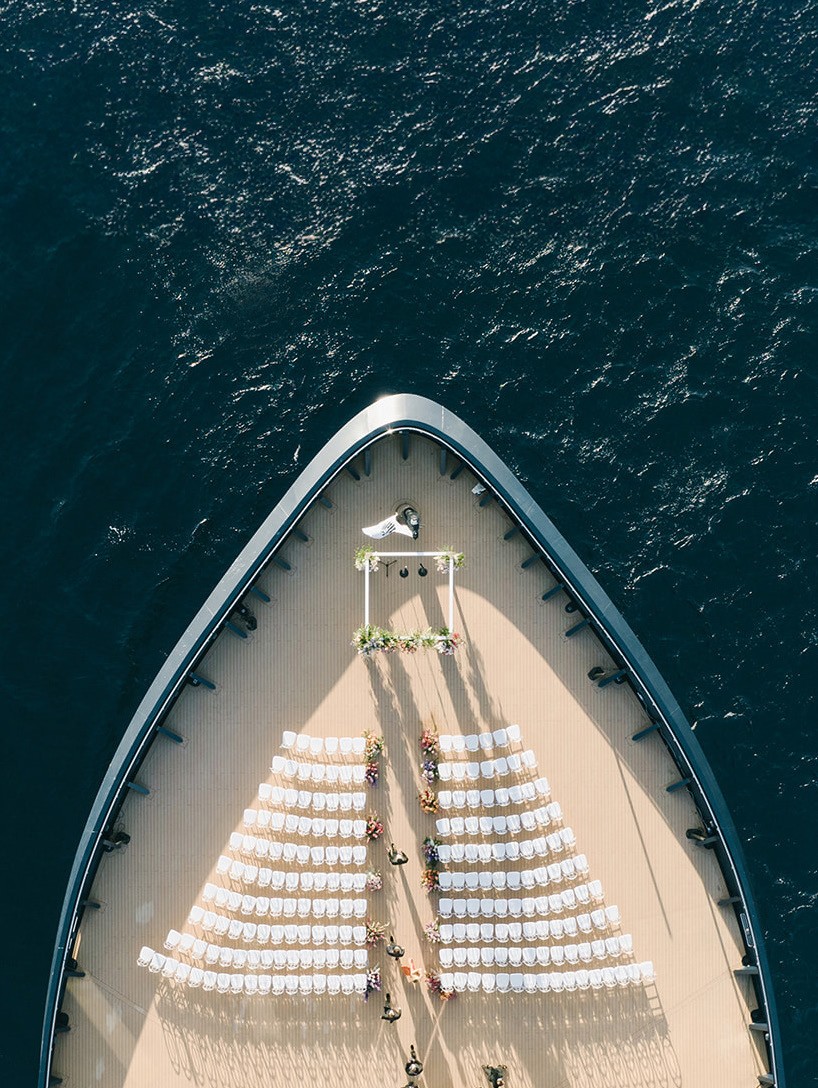
Image: The Ritz-Carlton Yacht Collection.
What follows is the part that usually stays out of sight until after the paperwork is signed: how many cabins actually qualify, how Tour Conductor credits are calculated, what deposits and release dates commit you to, and when forming a group is the wrong call. How to make a group of people comfortable together at sea is a separate essay.
Policy note: group programmes vary by market, sailing, booking channel, cabin category, and contract type — even within one cruise line, a standard group, a wedding block, and a charter can follow different rules. The figures below were reviewed on 31 August 2026 against publicly available cruise-line pages. They are reference points, not a quotation: actual group fares, complimentary berths, and exclusive amenities (private events, excursions, onboard credit) must be requested and confirmed in writing per sailing, cabin, and headcount. The written terms for your sailing always take precedence.
The short version
A group cruise is a booking in which a defined party — family, friends, colleagues — is recognized by the line as a single block, with its own pricing, deposit schedule, and concessions. Formalizing usually becomes relevant at five to eight staterooms: the mainstream baseline is 8 staterooms (16 guests), while several lines and most luxury programmes start lower, counting by suite or by guest rather than by cabin. Groups may earn a Tour Conductor credit, commonly benchmarked to one lower berth per eight sailed cabins. None of it is automatic, and none of it guarantees the group fare will beat every public promotion — the sections below show where the structure starts to pay for itself.
Why this belongs on your radar — for families, for teams, for starting early
Most people hear "group cruise" and picture the wrong thing: badges, banquets, a microphone at the front of the room. The real version is quieter and far more personal. It's a format built for the one problem every group trip actually has — getting everyone you care about into the same place at the same time, and then not having to run it yourself.
For families. You know the reunion you keep meaning to plan, the one that always stalls on who books the house and who drives the six cars to the same restaurant. On a ship, that whole weight lifts. You wake, breakfast is already there, and the only decision is whether to swim before or after. What stays is the part you actually wanted — slow mornings, long dinners, the unhurried hours with the people you came for. That's the whole reason to travel together, and it's why we keep saying you are more important than the destination.

Image: Disney Cruise Line.
For teams and circles of friends. The same logic, off the family tree. A company offsite people remember for the right reasons. An alumni trip. Three households marking a milestone birthday. The ship becomes the backdrop and the logistics at once, so the group spends its energy on each other instead of on the plan. Private dining, a room that's yours for the evening, cabins held together — the occasion gets designed, not improvised.
And the timing. Group space on most sailings is quietly blocked months ahead — at Wonderia Travel, our planning windows run nine to eighteen months out. If a late-2026 sailing is what you have in mind, this is close to the last window in which a group can still take shape; look further out and the earlier you start, the more room you have to choose: the cabins, the dates, the slice of the ship that makes it feel like yours. After a few years in which gathering everyone became rarer and more deliberate, the appetite for one real, shared stretch of time has rarely been stronger.
None of this asks you to arrive with a plan. Only with the feeling that the people matter more than the itinerary — and the instinct to ask what's possible before the best space is gone.
What a group cruise actually is — and how it differs from booking separately
Two ideas get tangled together, so let's pull them apart first.
"We are travelling as a group" is a social fact. You can travel with twenty friends on twenty separate bookings and still eat dinner together every night.
"We have a formal group cruise booking" is a commercial fact. It means the line has recognized your party as a group, assigned blocked space, and extended group-specific terms.
You do not need a formal group contract to travel together. But once you cross a certain size, a formal structure usually saves money, secures space, and opens benefits that individual bookings cannot. Here is what that looks like in practice:
Dimension | Group cruise booking | Individual (FIT) booking |
|---|---|---|
Minimum size | Typically 8 staterooms / 16 guests (Carnival from 5, NCL from 5–7) | None |
Pricing | Group rates plus concessions (TC credit, onboard credit, amenities) | Only retail promotions |
Payment | Each guest pays individually via the advisor; organizer not liable | Self-managed |
Flexibility | Locked contract; dropping below minimum can forfeit perks | Easy name or date changes |
Dining & events | Pre-arranged group seating, private event space | Self-coordinated |
Coordination | Advisor plus ship coordinator; organizer is the social host | Personal only |
In other words, a group booking never really sells a "cheaper ticket." It sells a managed relationship: space is protected, terms are negotiated, dining and events are arranged in advance. What you are buying is certainty, not a discount.
Who it's for — and whether it's for you
Group cruises serve more than one kind of occasion. The ones we plan for most:
Multigenerational family reunions — three or four generations on one vessel, kids programmed, grandparents given quiet.
Friends' milestones — birthdays, anniversaries, or simply a circle of households.
Weddings and vow renewals at sea.
Corporate incentives and retreats — teams rewarded or pulled together offsite.
Affinity groups — alumni networks, clubs, civic or professional associations, bound by a relationship that predates the trip.

Image: Bhong Bahala.
Each occasion implies a different ship, cabin mix, and rhythm. A corporate retreat needs reliable connectivity and meeting space; a multigenerational family needs kids' programming and quiet zones in the same hull. The occasion should shape the booking, not the other way around.
A honest caveat: if your party is only three or four cabins and everyone wants to stay flexible, linked individual reservations are often more comfortable than forcing a group — you still connect dining and amenities without carrying the group's deposit obligations. A group isn't better because it's bigger; it becomes worth it once the size justifies the structure. So the first question isn't "should we form a group," but "has this party reached the size where it needs to be managed as one."
What it takes to qualify: the minimums, all tiers
This is the question we're asked most, and the one clients most like to compare against. The short version first:
The prevailing baseline on the major contemporary lines is eight staterooms at double occupancy (sixteen lower berths) to qualify for formal group terms; Norwegian (NCL) recognizes groups at 5–7 staterooms, and Carnival can begin at five. But if you want to qualify with fewer people, the luxury tier is often more forgiving — they count by suite or guest: Crystal at 4 suites, Seabourn / Explora / Four Seasons from 5 suites. The full table, by contemporary / premium / luxury tier:
Cruise line | Minimum group threshold | Tour Conductor (TC) ratio | Key notes |
|---|---|---|---|
Carnival | 8 staterooms | 1 / 15 full-fare lower berths | Space held ~120–150 days out without deposit; points for champagne, cocktail parties, onboard credit |
Royal Caribbean | 8 staterooms + 16 guests (non-contract) | 1 / 16 full-fare guests (double) | Contract groups up to 199; 16+ deposited rooms earns 4 group points |
Norwegian (NCL) | from 5 staterooms (some channels cite 8) | 1 / 10 berths | Includes Free at Sea; aggressive group pricing, better in shoulder season |
MSC | 8 staterooms | 1 / 15 full-fare guests (excl. 3rd/4th) | Standard cap 70 rooms (71+ = large group); strong children's fares |
Princess | from 10 guests (~5 rooms, non-contract) | 1 / 16 full-fare lower berths | Contract cap 252 guests; strong Alaska / Europe |
Costa | 8 staterooms (industry-standard floor) | 1 / 16 passengers | European mainstream; custom pricing, no uniform public discount ratio |
P&O Cruises | 8 staterooms | Per sailing | UK mainstream; terms float by sailing |
AIDA | 8 staterooms | Per sailing | German mainstream; terms float by sailing |
Cruise line | Minimum group threshold | Tour Conductor (TC) ratio | Key notes |
|---|---|---|---|
Celebrity | 8 rooms (no-deposit) / 17 rooms (deposit) / Galápagos 5 | 1 / 16 full-fare guests (double) | High group OBC ($50–150/room); private receptions at 12+ rooms |
Holland America | 8 staterooms | 1 / 16 guests (GAP can drop to 1/13 or 1/11) | Points: 5–9 days 4, 10–20 days & Alaska 6, 21+ days 8, Legendary 10 |
Cunard | from 10 guests (non-contract) / 200 (contract) | 1 / 15 full-fare lower-berth guests | Up to 10 group points (more if booked early); transatlantic benchmark |
Virgin Voyages | 8 staterooms (Circles / wedding: no minimum) | 1 / 10 rooms (any category) = 1 free Sea Terrace | 18+ ship; deposit 20% of cabin fare |
Azamara | 8 rooms / 16 guests (non-contract) / 26 (contract) | 1 / 12 booked rooms | 90-day no-deposit hold; points for receptions, dining, credit, TC reduction |
Oceania | 8 suites | ≤16 days 1/15 berths; ≥17 days 1/11 | No deposit; lifetime price protection; dining strength |
Viking Ocean | 5 staterooms | 1 / 15 paying guests (max 4) | Deposit $500/person; strictly adults-only (18+) |
Windstar | from 10 guests | Star 1/9 guests; Star Adventurer 1/7 | No deposit, price-protected not space-protected; small sailing yachts |
Disney | 8 staterooms | 1 / 8 paid cabins (best industry ratio, select sailings) | Strongest for families / multigen; character meet-and-greets at 20+ rooms |
Cruise line | Minimum group threshold | Tour Conductor (TC) ratio | Key notes |
|---|---|---|---|
Seabourn | 5 suites / 10 guests | 1 / 7 or 1 / 9 paying guests (max 8) | Post-TC option $250/suite (≤9 days) or $500/suite (≥10 days) OBC or commission; max group Odyssey 40, Encore 50 suites |
Silversea | 8–16 rooms (by founding tier) | Super Adv 7-pay-1-free; Adv 9; Std 11; Res 15 | No GAP; six-star all-suite |
Regent Seven Seas | 8 suites | 1 / 10 guests (sometimes lower) | No deposit; max 1 group per ship per month; truly all-inclusive (excursions included) |
Crystal | 4 suites | 1:7 to 1:15 (by sail date; min 4 rooms earns 1, max 4) | Price protected 90 days or to final payment; butler service |
Ritz-Carlton Yacht Collection | FIT 12 suites (cap 30/50); Incentive 10 suites (cap 30) | 1 / 12 suites (max 2 free Terrace Suites) | 25% deposit/suite; 90-day non-liable price lock; $200/suite yacht credit + cocktail party + 1 group dinner |
Explora Journeys | Journey Together: 5 suites / 10 guests; Journey Together Plus: 10 suites / 20 guests (1 host suite free) | Separate sales 1/11 rooms free 1 | Full-ship charter available; all oceanview suites with private terrace |
Four Seasons Yachts | Non-contract 5–9 suites (≤20 guests); Contract 10+ suites (21+ guests); Full charter 31+ suites or 60+ guests | Per sailing / contract | Suites connect horizontally / vertically (100+ combinations); whole-deck blocks possible; 1:1 service ratio |
SeaDream Yacht Club | 6–18 double staterooms (defines a group) | Per sailing | Full charter 56 rooms / 112 guests; 1:1 service; casual-elegant yachts |
Ponant | from 5 rooms (US site); Europe tiers 6 / 9 / 11 rooms | Free room 1/5–1/10 (by condition tier) | Full charter available; French luxury, expedition & polar strength |
Scenic (Eclipse / yacht & river) | from 10 guests (Europe/SE-Asia river, Eclipse); Douro 12 | Europe/SE-Asia 1/9 guests; Douro 1/11 | 90-guest cap; unlimited price protection |
Paul Gauguin | from 10 guests = 5% group discount | Per sailing | Tahiti specialist, 330 guests / 165 cabins; all-inclusive |
Emerald Cruises (yacht & river) | from 10 guests (Europe/SE-Asia river, yacht); Douro 12 | Europe/SE-Asia 1/9; Douro 1/11 | 90-guest cap; yacht line as luxury newcomer |
Basis: TC = Tour Conductor (complimentary berth). "Minimum threshold" means the fewest cabins, suites, or guests needed to trigger group rates / group amenities. Contemporary and premium lines usually count by cabin; luxury / yacht lines usually count by suite or guest and often run on a "custom / charter" logic where the threshold is more flexible than the number suggests. Figures float by sailing — verify your specific sailing's terms with us before signing.
A few points worth pulling out:
Fewest people to qualify: 8 cabins is the mainstream starting line, but for a lower headcount the luxury tier is friendlier — Crystal (4 suites), Seabourn / Explora / Four Seasons (from 5 suites) count by suite / guest rather than hard-capping at 8 cabins.
Maximize the TC credit: Disney (1/8), Seabourn (1/7–1/9), and Ponant (1/5 at top condition tier) lead; mainstream lines sit at 1/15–1/16.
Large groups / incentives / private celebrations: luxury and yacht lines broadly support full-ship charter and connecting suites / whole-deck blocks (Ritz-Carlton, Four Seasons, SeaDream, Ponant, Explora) — something the big mainstream ships cannot do.
Lead time: book mainstream space 9–18 months out; luxury / yacht popular sailings often sell out group inventory 12+ months ahead and commonly carry a 90-day price-lock window.
Where we could point to the public wording:
These five are the ones we can cite on the record. The rest of the table is drawn from published group policies and advisor channels, which is exactly why the written terms for your sailing govern.
The money question: is a group rate actually cheaper?
The most important caveat first: not always.
A group rate can lock pricing early, reduce deposit pressure, add amenities, and protect space. But an aggressive individual promotion can occasionally outperform it, especially on peak sailings where lines discount least. The right comparison is never "group vs retail" in the abstract; it is the actual group contract versus the actual individual offer for that specific sailing.
Two rules of thumb: shoulder-season or repositioning sailings tend to carry thicker group amenity points, so the group usually wins; peak popular sailings may see individual promotions drop below the group rate — get both quotes before you commit.
Whatever the season, compare at least these five things before deciding:
Cruise fare — is the base price lower, equal, or higher?
Included value — are drinks, Wi-Fi, gratuities, onboard credit, or private events part of it?
Deposit terms — from what point does the money become non-refundable?
Flexibility — what happens after a name change, a cancellation, or a cabin-category change?
Group value — what protected space, coordinated dining, or private access would be hard to recreate on individual bookings?
The best group contract is rarely the one with the lowest first number. It is the one whose total cost and obligations still make sense after the group changes shape — which groups almost always do.
The real machinery behind group economics comes down to two things.
How the Tour Conductor (TC) credit actually works
Strictly speaking, "free cabin" is convenient shorthand rather than an accurate description. A Tour Conductor credit is a fare credit earned once the group meets a specified number of qualifying staterooms or guests, commonly benchmarked to the net base fare of one lower berth. In practice it is often calculated after the group has sailed — a design that protects the line and the group alike, since a single late cancellation cannot erase the entire benefit — but the qualifying ratio, the cabin category used to value it, the timing, and the permitted uses all come from your contract rather than from one universal rule.
Three mechanics decide its value:
Modal-category weighting. The credit is valued on the stateroom tier with the highest booking volume in the group — not the suite the leader occupies. Ten inside cabins and six balconies means the credit is calculated on the inside tier.
Exclusions. Non-commissionable fares, government taxes, port fees, and daily gratuities are excluded. Whoever occupies the complimentary berth still owes those incidentals.
Disbursement options. The value can go to the leader as organizing compensation, convert to an agency check, spread as onboard credit across all guests, or pool into a master account funding a group cocktail hour or private excursion.
The "pay how many, get one free" ratios per line are in the rightmost column of the three tables above. Memory aid: mainstream lines sit at 1/15–1/16 with Disney best at 1/8; luxury lines are often more generous (Seabourn 1/7–1/9, Ponant 1/5 at top tier). Exactly how much is issued also depends on final count, sail date, and negotiation.
What group amenity points (GAP) buy
Beyond the TC credit, lines assign your group a pool of amenity points at space allocation, redeemable for onboard credit, private-lounge hours, specialty dining, venue space, and Wi-Fi. The points move inversely with demand: a holiday or peak sailing may earn only a point or two, while a shoulder-season or repositioning voyage can earn several times that.
Cruise line | Standard group threshold | Core amenity currency | Representative options |
|---|---|---|---|
Royal Caribbean | 8 cabins / 16 guests | 2–8 GAP points (~$25 onboard credit per 2 points) | Onboard credit, private cocktail parties, specialty dining, venue space |
Norwegian (NCL) | 5–7 cabins | Structured "Group Perks" tiering | Beverage package, prepaid gratuities, specialty dining, internet, per-port excursion credit |
Celebrity | 8 cabins / 16 guests | GAP-equivalent amenity matrix | Wi-Fi and beverage bundles, upgrades, onboard credit, private lounge access |
Carnival | 8 cabins / 16 guests (from 5) | Dynamic group amenity points | Shared onboard credit, wine/champagne delivery, photo packages, private social hours |
Holland America | 8 staterooms | 5–9 days 4 pts; 10–20 days & Alaska 6; 21+ days 8; Legendary 10 | Receptions, credit, TC reduction |
Azamara | 8 rooms / 16 guests | Points for receptions, dining, credit, TC reduction | 90-day no-deposit hold |
The practical read: the calmer the date, the more the line is willing to sweeten the arrangement. To thicken amenities, place the group in a shoulder or repositioning window.
At the luxury tier, the game changes entirely
At the upper end, the conversation stops being about "how much off" and starts being about "how much control." Lines such as Explora Journeys, The Ritz-Carlton Yacht Collection, Crystal, and Four Seasons Yachts structure group value through suite minimums, privacy, and exclusive space rather than a visible percentage. Commonly cited thresholds include a minimum of several suites to open a group conversation, complimentary suite credits at defined ratios, and contract terms that lock rates and specify attrition schedules.
For a high-end group, the value often shows up as connected or adjacent suites; private dining and a dedicated event space; control over part of the ship (whole-deck block, full charter) — not a slashed fare. Exact terms vary by line and sailing and are confirmed at quotation. For large groups, corporate incentives, or private celebrations, luxury and yacht lines support full-ship charter plus connecting suites (Ritz-Carlton, Four Seasons, SeaDream, Ponant, Explora) — impossible on the mainstream megaships.
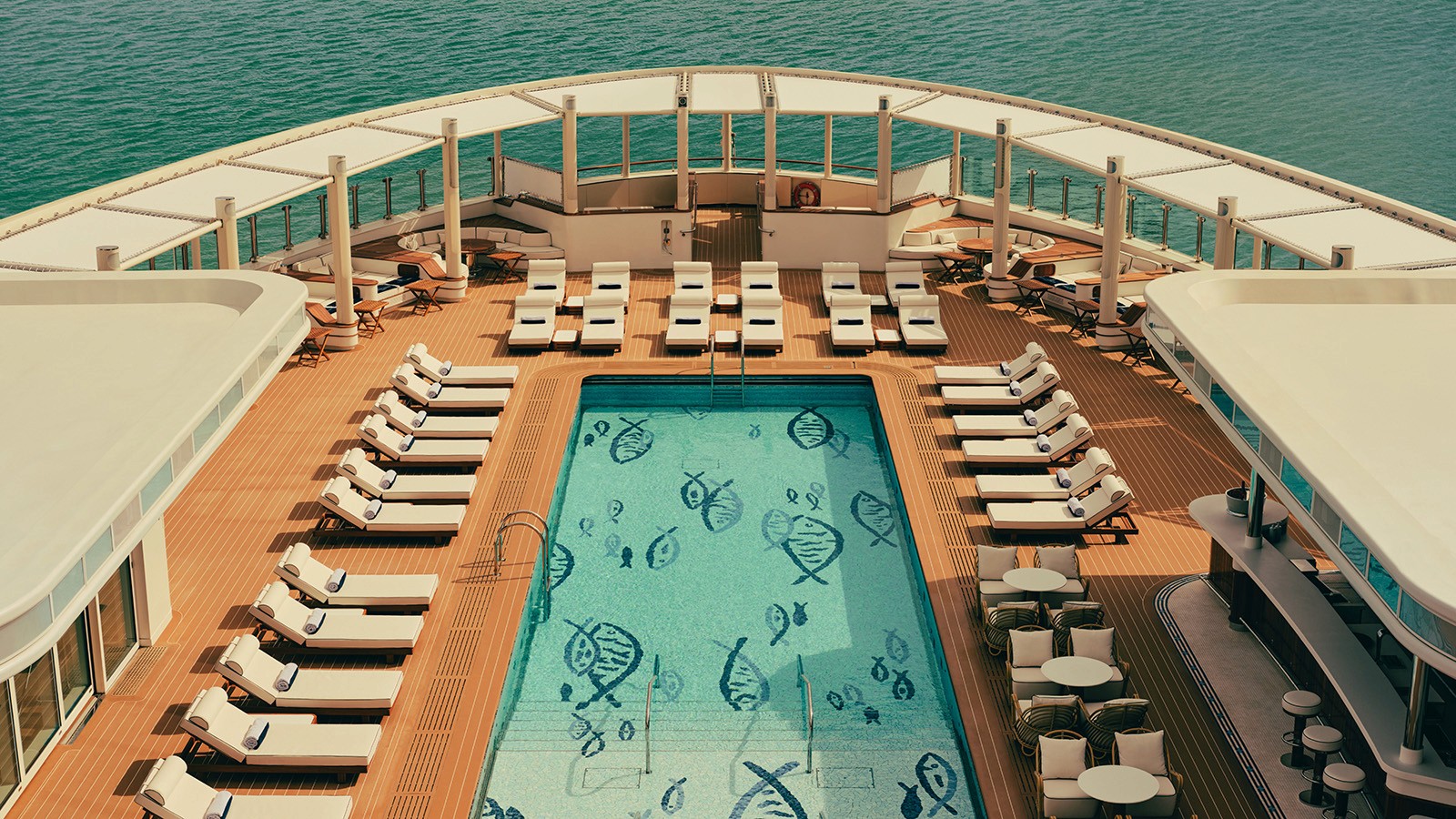
Image: Four Seasons Yachts.
Before you ask for a quote: six answers worth having
You do not need a finished itinerary, but a useful group proposal depends on more than a headcount. Have a working answer to these:
Who is this for? Multigenerational family, friends, wedding guests, clients, or colleagues?
How firm are the dates? A narrow window protects the occasion; a wider one usually improves cabin choice and value.
What is the comfortable budget range? A mixed group may need inside cabins, balconies, and suites on the same sailing.
How much togetherness is wanted? Dinner every night, two anchor events, or largely independent days?
What is non-negotiable? Connecting rooms, accessibility, children's programming, meeting space, or a specific departure port?
Who decides? One clear point of contact stops twenty preferences from becoming twenty parallel plans.
These answers determine the ship far more reliably than any ranking. A family with toddlers, grandparents, and a need for connected rooms should not choose by the same criteria as an adult incentive group that values quiet meeting space and evening privacy.

Image: sayan Nath.
Choosing a line: what you want to feel at sea
There is no universally "best" cruise line for groups. The better question is what this specific group should feel like at sea.
Your group profile | Usually best-fit lines | Why |
|---|---|---|
Adults, child-free, grown-up mid-luxury | Virgin Voyages, Viking | 18+ ships, calmer pace |
Calmer tone, fewer children | Celebrity, Princess | Restrained atmosphere, families and adults both served |
Fun, activity, a line's private destination | Royal Caribbean | Big ships, lots to do, private islands |
Longer, scenic, pricier | Alaska lines (mostly 7+ nights) | Long voyages, view-first |
Multigenerational, kids' programming essential | Disney, Royal Caribbean | Strong kids' clubs and family facilities |
Corporate incentive, quiet meeting space | Holland America, Celebrity, luxury / yacht lines | Meeting rooms and private event venues |
High-net-worth private celebration, full charter | Ritz-Carlton Yacht Collection, Four Seasons, SeaDream, Ponant, Explora | All-suite, connecting, deck / ship charter |
The departure date matters almost as much as the ship: most group cruises are blocked-space groups on otherwise public sailings, so a themed voyage or another large affinity group on the same date can change the atmosphere. Research the ship and the specific date, not the ship alone.
Cabins and the dinner table: don't force matching cabins, do anchor the evening
Don't force identical cabins. Let each household pick the tier it can comfortably afford, from inside to suite, and keep the group unified through the central manifest so dining and amenities are shared regardless of where anyone sleeps. A leader's suite can double as the informal hospitality hub. Budget differences handled this way prevent the quiet resentment that rigid uniformity creates.
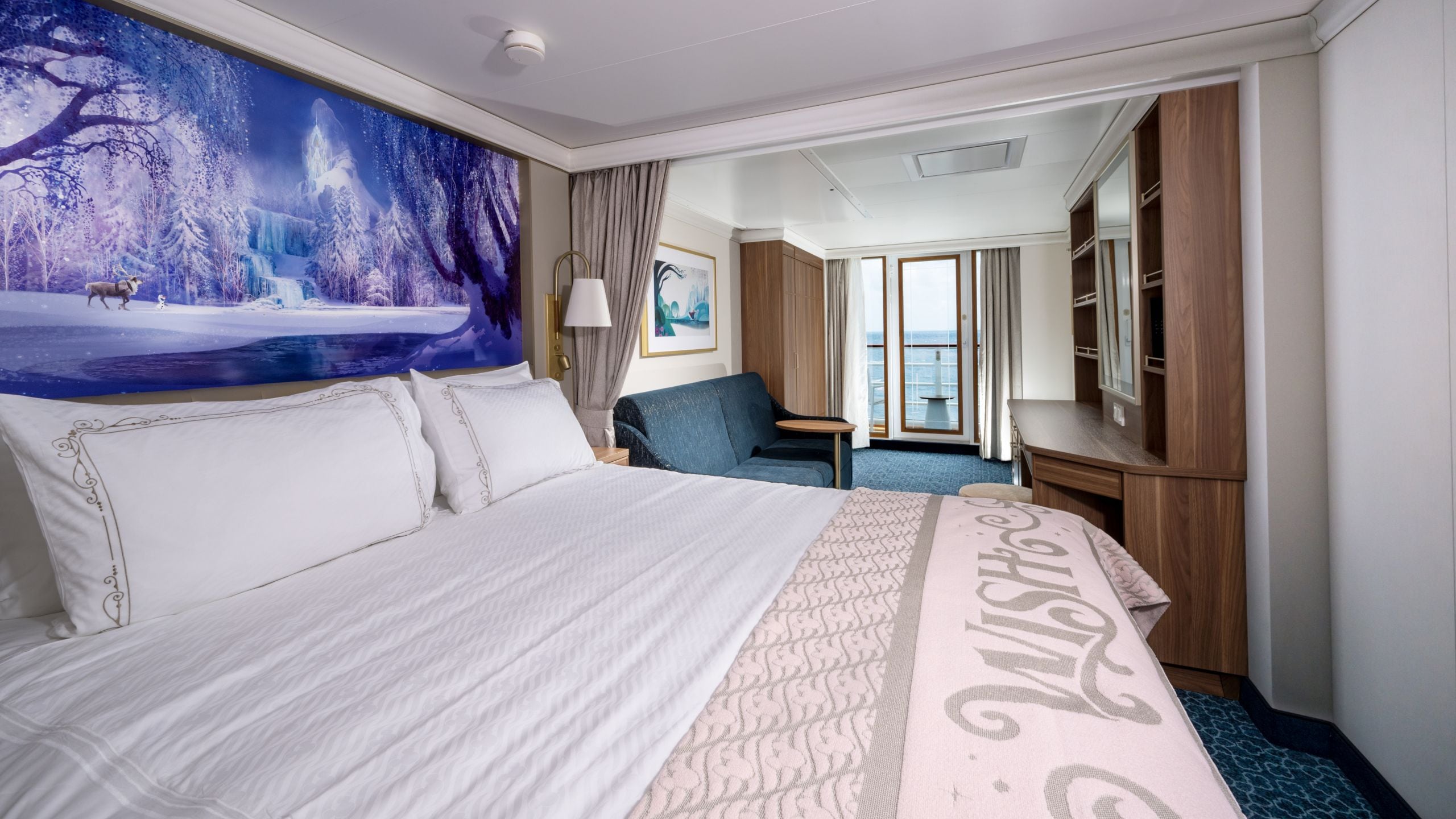
Image: Disney Cruise Line.
The dinner table earns its own paragraph. Above eight guests, fixed seating is usually the calmer choice: traditional fixed dining links your group's reservations for the whole voyage, assigning contiguous tables with a dedicated service team — a reliable nightly anchor with no wait. Flexible ("freestyle" / "my time") dining works for couples and small families but frays above eight, as host stations cannot easily reconfigure a dozen or forty contiguous seats at peak; groups get split across tables, teams, and venues. For anniversaries, weddings, or corporate awards, smaller specialty venues and private rooms answer the occasion — secured by contracting private space or early buyouts, often using amenity points through the group events department, and arranged well ahead.
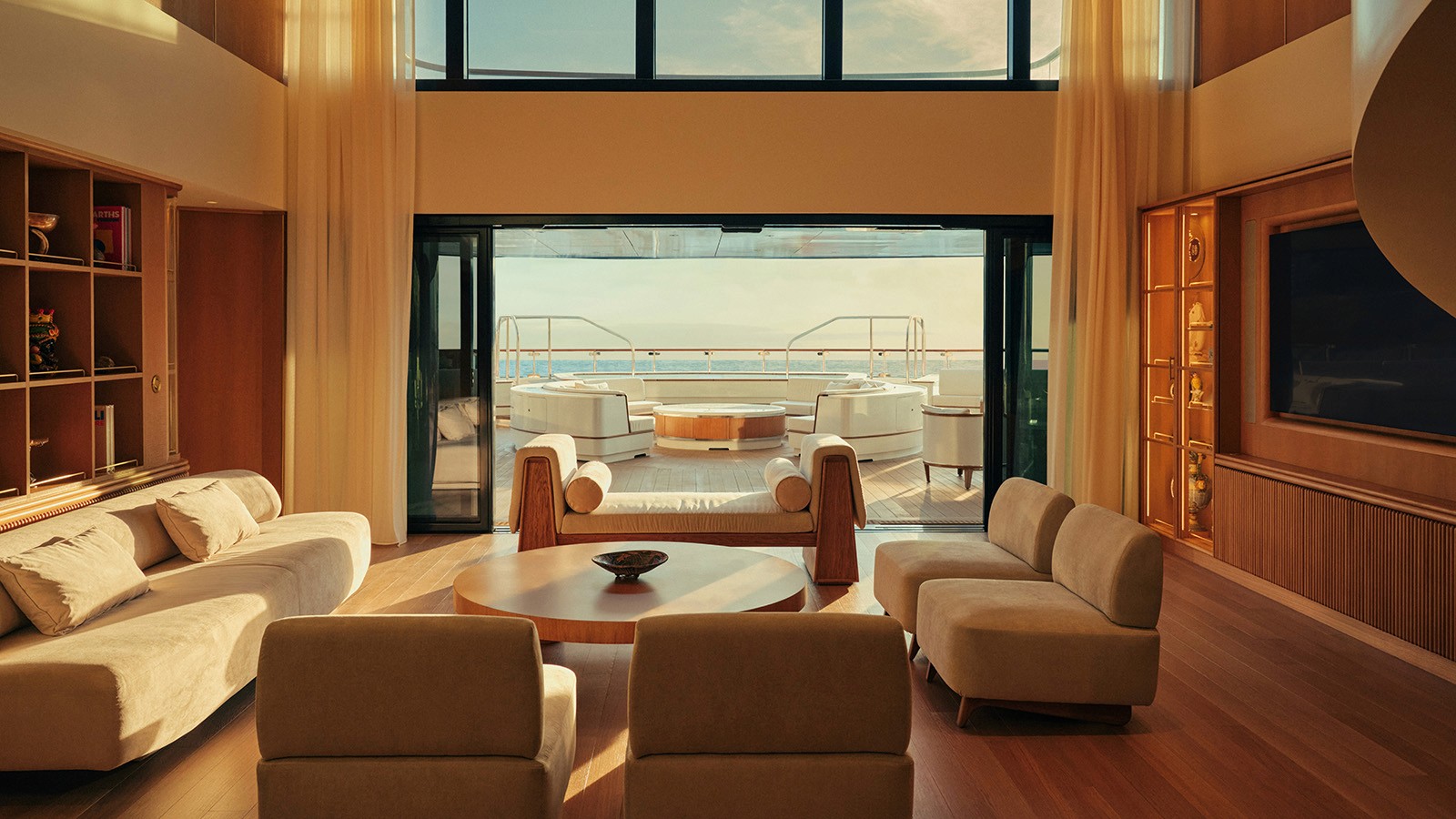
Image: Four Seasons Yachts.
Money, contracts, and risk: what to understand before you sign
The fastest way to strain a relationship is to let one person carry everyone else's money. So our own rule is simple: whenever the structure allows, each household pays its own travel costs directly through us, while the reservations stay linked centrally. A third party — your advisor — handling the money protects both the finances and the relationships that brought the group together, which is exactly what frays when one person tries to hold it all.
Group contracts are stricter than individual ones. These are the risk points worth you seeing clearly — and worth someone watching on your behalf:
Dropping below the minimum forfeits perks: undeposited space reverts to general inventory on the recall date.
Deposits are often non-refundable: this is exactly why a clear cancellation policy, set before booking, and travel insurance matter.
Attrition: guests dropping out reduce booked cabins and can affect concessions and free-berth counts.
Revenue management enforces recall dates, typically phased at 150, 120, 90, and 60 days before departure. Any staterooms in your block that are not yet deposited quietly revert to general inventory at those gates. A group that drifts — cabins promised but not paid — can watch its block shrink and its perks evaporate. A calm group process treats recall dates as real deadlines: collect deposits on schedule, confirm names on schedule, respect final payment. The block is not "yours" until the deadlines are met.
Compliance details worth deciding early:
Minors travelling without both parents typically need notarized parental consent; passports should be valid well beyond the voyage.
Arrive at least 24 hours before embarkation. A morning-of flight is a missed-ship risk no insurance comfortably covers.
Beverage-package pairing: on many lines, if one adult in a stateroom buys a package, all adults in that cabin must match. Plan cabin pairings at booking.
One source of truth: an advisor-managed hub for terminal, boarding, and shipboard policy beats an unvetted group chat where half the information is stale.
This is also the moment to settle travel insurance. We strongly recommend cover appropriate to the itinerary — cancellation, medical care, and evacuation on longer or remote sailings. The detail that matters most is evacuation cover with real limits: enough for an air ambulance, not a small medical bill. Cruise-line policies often require upfront payment and later reimbursement. Coverage limits, exclusions, and pre-existing-condition rules matter more than whether an insurance box has been ticked. Build it in before anyone pays a deposit.
Onboard communication: finding people inside a steel hull
A ship is not like being on land. Each major line runs an intranet app on the ship's local network, enabling schedules and ship-to-ship messaging without satellite data. Free or nominal (Carnival has charged a few dollars per device), but push notifications often fail on captive local networks, so agree to check the app at set times.
Cruise line | Onboard communication app / system |
|---|---|
Royal Caribbean | Royal Caribbean app |
Princess | MedallionClass |
Carnival | HUB |
Norwegian (NCL) | NCL app |
Virgin Voyages | Voyage Planner / shipboard system |
Celebrity | Celebrity app |
Holland America | Navigator app |
Low-tech tools still earn their place: a small magnetic whiteboard on a cabin door for asynchronous corridor messages; stateroom phones for reliable cabin-to-cabin voice; and an agreed home base and a few predictable meeting points. Walkie-talkies perform poorly on steel vessels (a Faraday effect) and are restricted on some lines. Full satellite Wi-Fi gives instant alerts but is costly across a large cohort and can create a class divide within the group. Agree one communication plan before sailing.
A planning timeline that doesn't panic
Starting early never hurts. The lead times below, by group type:
Group type | Suggested lead time | Reason |
|---|---|---|
Ordinary small group (8–15 rooms) | 6–12 months | Mainstream space lock and base amenities sufficient |
Multigenerational / major celebration | 12+ months | Specific connecting cabins and family facilities in demand |
Luxury / high-end sailing | 12+ months | Specific suites, connecting rooms, private venues scarce |
Corporate incentive / full charter | 12–18 months or more | Charter and whole-deck blocks need line scheduling |
For an ordinary group 6–12 months out, a celebration / multigen / luxury group 12+ months out, a calm timeline looks like this:
Define the trip — dates, port, destination, size, cabin mix.
Engage an advisor and lock the contract — request a group quote, confirm the rate, sign while space holds.
Confirm size and collect deposits — respect recall gates.
Book flights, hotels, transfers — pre-cruise hotel block; arrive 24h early; keep the return flight open.
Coordinate cabins and dining — adjacent or connecting rooms; confirm group seating.
Plan excursions and events — reserve shore excursions and show times; schedule private events early.
Send the compliance packet — at least 90 days out: arrival rule, documents, app setup, whiteboard tip, beverage policy, insurance.
Final payment and embarkation — complete payment, verify manifest, meet as a group at the terminal.
Questions we're asked all the time
What is a group cruise? A sailing where a defined party travels under a coordinated reservation structure — linked bookings treated as one block by the cruise line, with its own pricing, deposit schedule, and concessions.
How many cabins do you need for a group rate? Usually eight staterooms (sixteen guests) at double occupancy across Royal Caribbean, Celebrity, Carnival, Princess, and Holland America. Carnival can start at five; NCL recognizes groups at five to seven. Below those thresholds, most benefits do not trigger. Luxury lines count by suite / guest: Crystal 4 suites, Seabourn / Explora / Four Seasons from 5 suites.
Do groups get a free cabin? Often, yes — but it is usually a Tour Conductor fare credit rather than a cabin with nothing owed on it. Expect roughly one lower berth per eight sailed cabins (Disney best at 1/8, Seabourn 1/7–1/9), plus amenity points for onboard credit and events. Taxes, port charges, and gratuities generally still apply, and the qualifying ratio, exclusions, value, and timing are set by your contract rather than by one universal rule.
Is a group rate always cheaper than booking separately? Not always. A group rate can lock pricing and add amenities, but an individual promotion can occasionally beat it, especially on peak sailings. Compare the actual contract against the actual individual offer for that sailing.
Do we all need the same cabin type? No. Allowing different tiers accommodates budgets and family structures. Prioritize location for those who need proximity or connecting rooms.
Should a group eat together every night? Dinner makes an excellent daily anchor, but attendance need not be compulsory. A few important meals plus freedom on other nights often works better.
Do we need a travel advisor for a group cruise? Not mandatory, but at eight cabins or more it changes things considerably. An advisor absorbs the administrative load, secures concessions you cannot get on your own, and lifts the money question — the one most likely to strain a friendship — off your shoulders.
When should we start planning? Six to twelve months for an ordinary small group; twelve months or more for a celebration, multigenerational family, or luxury sailing; twelve to eighteen months for a corporate charter.
Is travel insurance necessary? Strongly recommended, with medical evacuation and cancellation coverage. For longer or remote itineraries it is essential.
About this guide, and the part we take on
Authority in travel planning comes from doing the unglamorous work accurately, again and again. Wonderia Travel 诗栖逸旅 is a quiet-luxury advisory and a Four Seasons Preferred Partner. We plan group voyages the way we plan any voyage for our clients: by reading the group before the itinerary, structuring the contract and cabin layout around the people actually going, and treating the human design as seriously as the logistics.
The difficult part of a group cruise is rarely choosing a ship from a list. It is reading the people accurately: who needs proximity, who needs independence, what the group can comfortably spend, and which promises have to survive the contract. Our goal is not to make everyone do everything together. It is to give the group enough shape that being together feels easy.

Image: Vitaly Gariev.
So what should you make of this article? A map to read before you hand the complexity over — so you know exactly what you're signing. Every figure in this guide — minimum thresholds, tour conductor ratios, recall-date gates, amenity points — moves with sailing, cabin, and headcount. Before you sign, it costs very little to check those numbers against the actual terms of your sailing. We are not handing you a table; we are making sure that table actually holds for your voyage.
The decisions that shape the trip — how much togetherness your group actually wants, which line fits its temperature, what happens if two cabins drop out — are the ones worth getting right before you sign. We think those through with you.
If you're considering taking a group to sea, speak with us before you commit to a contract. The early decisions are the ones that define the whole voyage. If you're only starting to wonder whether this is for you, that's the right moment to ask — the earlier a group takes shape, the more it can hold.
You are more important than the destination.